The digital transformation is also changing the requirements placed on modern port infrastructure. Across extensive operational sites, people, vehicles and goods must be reliably connected, safety-critical areas monitored, and potential hazards identified at an early stage. At the same time, new digital applications require a high-performance and scalable communications infrastructure.
At the seaport of Wismar, a private 5G platform now forms the basis for precisely these requirements. In collaboration with COCUS, the port has further developed its existing 5G infrastructure into a fully operational platform for smart security applications. The private 5G network connects cameras, radar systems and other devices across the entire port site, whilst also laying the foundations for future automation applications.
Reliable connectivity for a sprawling port area
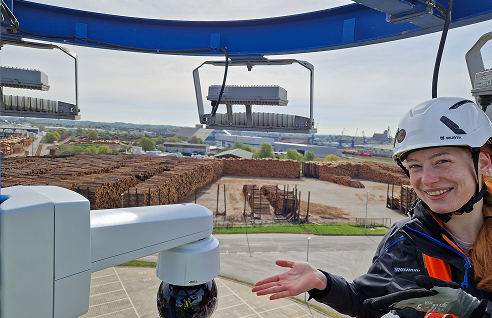
The seaport of Wismar covers 70.7 hectares. Among other things, timber, wood chips, bark, scrap metal, liquid goods and vehicles are stored and handled on the site.
These different operational areas entail specific safety requirements. Wood chips and bark, for example, can heat up from within and catch fire. At the same time, scrap metal and vehicles may contain lithium batteries. Added to this are railway tracks, transport routes and a harbour boundary that runs partly along the water’s edge. Product information, materials, substance data and dependencies can be linked together and represented in a digital product model. Missing or contradictory information can also be identified more quickly in this way.
To ensure reliable monitoring, cameras and sensors must be able to be deployed where they are required for operational and safety reasons. However, many of these areas did not have an existing network connection. Widespread cabling would have required extensive civil engineering work whilst port operations were ongoing.
A private 5G infrastructure provides the necessary flexibility in this regard and enables reliable connectivity even at locations where traditional cabling would only be feasible at considerable expense.
Private 5G as the digital backbone
Building on the PORTABLE 5.0 research project, the Wismar Seaport’s private 5G network was further developed into a productive infrastructure in collaboration with COCUS. The port operates the network itself, thereby retaining control over both the network and the data.
At the heart of the solution lies the port’s own 5G core network. It forms the central communications hub for mobile devices, vehicles and the integrated security applications. The data remains within the port premises, whilst security-related communications take place independently of public mobile networks.
The 5G network does not merely serve the purpose of general connectivity. It forms the transport layer for the entire security solution. Cameras, radar systems and loudspeakers are connected via the private 5G infrastructure and transmit their data in real time to the digital control centre.
This creates a shared communication platform on which different applications and systems can be integrated.
Smart security applications in the port
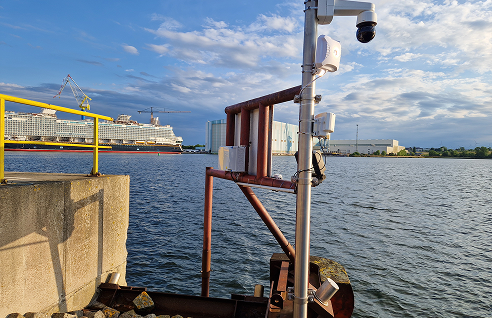
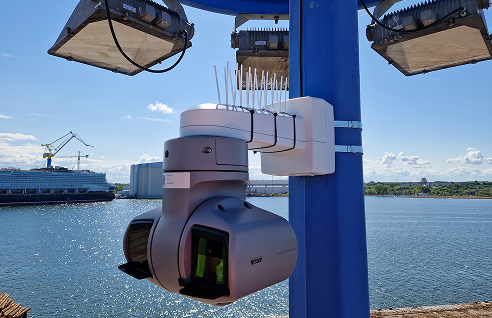
Using the private 5G infrastructure, a central security platform comprising 21 video cameras, including four thermal cameras, three security radars and four network loudspeakers, was set up across a total of 20 locations.
Radar and pan-tilt cameras are combined to provide perimeter protection. People can be detected and tracked at a distance of up to 60 metres. Individually defined surveillance and alarm zones enable the automatic detection of fence crossings, unauthorised access or people in defined danger zones. The Control Centre can respond directly to incidents via the integrated loudspeakers where necessary.
Another key focus is on early fire detection. Thermal cameras monitor areas such as storage facilities and detect temperature anomalies and critical hotspots before visible flames develop. An alarm can be triggered automatically when temperatures exceed 120 °C. The relevant temperature data and alerts are transmitted in real time to the control centre via the private 5G network.
Data protection was also taken into account during implementation. In defined areas, personal image data can be automatically masked within the cameras themselves. This makes it possible to combine intelligent security applications with the requirements for the protection of personal data.