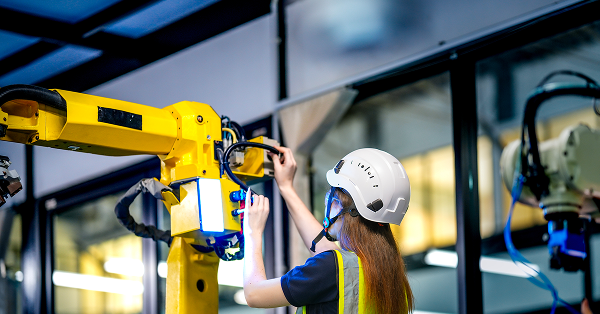
In production and logistics, machines, controllers and sensors constantly exchange data. As long as this relates purely to the process itself, the connection must, above all, be fast and reliable. However, as soon as people need to be protected by an emergency stop, a safety door or the safe stopping of an automated guided vehicle, significantly stricter requirements apply. This is precisely where two protocols share the workload: PROFINET and PROFIsafe.
ATLAS by COCUS: PROFINET and PROFIsafe via 5G
With ATLAS, COCUS provides an industrial 5G infrastructure that enables PROFINET and PROFIsafe communication to operate without any changes to the existing automation architecture. For businesses, this means that mobile machines and automated guided vehicles can be integrated into existing plants without the need for fixed cabling or a switch to a new communication protocol.
A look at the two logs shows why this works.
PROFINET and PROFIsafe: two functions, one infrastructure
PROFINET is the standard used by industrial systems to communicate. It connects control systems with machines, drives and sensors, ensuring that commands, status messages and diagnostic data are transmitted in real time. Reliability in terms of timing is crucial: the data must not only arrive, but arrive on time.
PROFIsafe is not a second, competing network, but rather an additional layer of protection on top of PROFINET. Safety-related signals travel in parallel via the same infrastructure as all other data; they are simply subject to additional safeguards. To this end, PROFIsafe checks every safety-related message to ensure that it is complete, unaltered and has actually been received by the correct recipient from the correct sender. As soon as any of these checks fails to pass unequivocally, a defined safety response is triggered. This enables safety functions to be implemented up to the highest level commonly used in factory automation. The practical advantage: no separate safety network, just one infrastructure and one engineering process.
PROFIsafe in practice: Safe stopping for driverless transport systems
An example: An autonomous transport system receives its travel instructions via PROFINET and continuously reports its position, speed and status. If its safety scanner detects a person in its path, this triggers more than just a standard notification. The signal is transmitted as a PROFIsafe message, and the vehicle is safely slowed down or brought to a halt.
The crucial factor here is the reaction time of the entire system, from the sensor to the vehicle coming to a standstill. In the case of a moving transport system, this time corresponds directly to the braking distance and is therefore the distance it must maintain from a person.
The same principle applies to emergency stop functions, safety doors, safe sensor systems and mobile machinery.
Network requirements: PROFIsafe safeguards safety, not availability
PROFIsafe reliably detects transmission errors, but it does not prevent them. The demands placed on the network therefore do not disappear; they simply shift: an unstable network does not jeopardise safety, but it does jeopardise availability.
This is because if signals arrive too late or irregularly, the system shuts down as a precaution. Whilst this is safe, it results in unplanned downtime. The network and safety functions must therefore be planned together from the outset; in this context, availability is directly linked to productivity. It is precisely at this interface between automation and the network that we at COCUS come into play.
What changes does a 5G infrastructure bring about?
When it comes to mobile machinery and automated guided vehicles, fixed cabling reaches its limits. 5G offers a wireless solution here, with predictable response times, high availability and stable handover between cells, even in areas of the factory floor where traditional Wi-Fi falls short.
It is important to clarify the division of roles: 5G replaces neither PROFINET nor PROFIsafe. These protocols continue to handle industrial and safety-related communication, whilst 5G merely provides the transport path. And because safety is managed at the endpoints rather than within the network, no restructuring of the safety architecture is required.
What requires attention is the time budget: the radio link must be designed so that signals arrive reliably within the expected time. This is a matter of network planning, not protocols.
ATLAS as a transport route
This is precisely the transport method that ATLAS provides. Proven automation meets flexible wireless connectivity, with a clear division of responsibilities between the protocol and the infrastructure.